The Return of the Posse Cut: How Hip-Hop Crews Are Taking Over Streaming
In an era built for solo singles, rap collectives are proving that chemistry still moves culture.
Entertainment · ReBL Culture Desk · August 16, 2026 · 3 min read
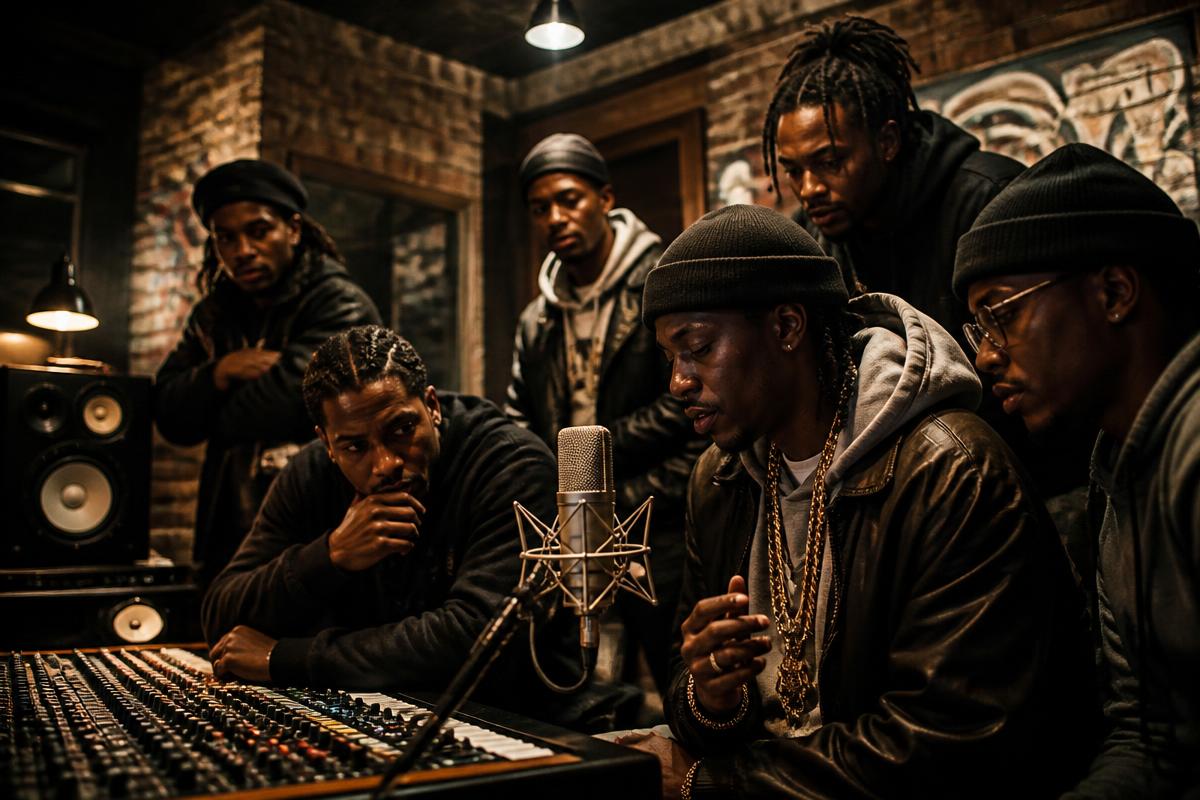
The solo single has ruled streaming for nearly a decade. Playlists are built around individual voices, algorithmic recommendations favor one artist at a time, and the economics of the business reward a constant drip of personal content. Yet the most exciting moments in hip-hop over the last few years have been communal: a group of rappers passing the microphone in a single room, finishing each other's punchlines, competing for the best verse on a beat that sounds like it belongs to all of them.
This is the posse cut, and it is back.
Not the nostalgic version from the nineties, where a marquee star rounded up his labelmates for a remix. The new posse cut is the organizing principle of an entire scene. Collectives are functioning as labels, media companies, and touring units all at once. They release albums with rotating cover stars, drop ciphers on social media, and build a shared visual language that makes every member more recognizable than any of them would be alone. The chemistry is the product.
Streaming rewards consistency, but it also rewards community. A fan who discovers one artist in a crew quickly learns the names of the other four. Playlists that include one song from a collective tend to include three. The group becomes a universe, and the universe becomes a reason to return. That is why the most durable careers in the current landscape are often attached to the most visible crews.
The economics work in their favor too. Recording costs drop when everyone shares the same studio. Merchandise designs carry the collective logo, the solo logo, and the inside jokes between them. Tours are easier to sell because the audience gets a whole roster instead of one headliner with an opening act they have never heard of. The posse cut is not just a song format anymore; it is a business model.
There is also a creative benefit that the numbers cannot capture. Competition inside a healthy crew is fuel. When your peers are in the same room, mediocrity is harder to hide. The best verse sets the bar, and the next verse has to clear it. That dynamic produces some of the most alive performances in contemporary rap, performances that feel less like content and more like sport.
Of course, the model is fragile. Egos, money, and uneven success can break a crew apart faster than any record deal. History is full of collectives that burned bright and split apart. The ones that survive tend to have a shared ethos that is bigger than any individual career.
The lesson is that culture still moves in groups. Algorithms can recommend a song, but they cannot manufacture the feeling of watching a crew that knows how to finish each other's sentences. That feeling is the reason the posse cut is back, and the reason it will probably outlast the next platform change too.
Quote 03“That level of familiarity is impossible to fake in a single session, which is why the strongest posse cuts usually come from crews that live in the same orbit year after year.”
02The craft of chemistry
A great posse cut is not just a string of verses. It is a sequence. The first voice sets the tone, the second voice complicates it, and the later voices either resolve the tension or escalate it. The beat has to leave room for contrast, and the mix has to make each voice feel distinct. Producers who understand this treat the posse cut like a dialogue, not a monologue.
The writing matters just as much. Artists who share a studio regularly develop shorthand. They know who will pick up the aggressive energy, who will slide in with melody, who will deliver the punchline that recontextualizes everything before it. That level of familiarity is impossible to fake in a single session, which is why the strongest posse cuts usually come from crews that live in the same orbit year after year.
Quote 01“They release albums with rotating cover stars, drop ciphers on social media, and build a shared visual language that makes every member more recognizable than any of them would be alone.”
03What it means for the listener
For the audience, the appeal is membership. A crew gives fans a roster to debate, a hierarchy to argue about, and a sense that they are witnessing something unfold in real time. The posse cut is the manifesto of that membership. It says: here is who we are, here is what we sound like together, and here is why you should care.
In a culture that increasingly fragments attention, that kind of collective identity is rare currency. The return of the posse cut is not nostalgia. It is proof that even in an age of solo streams, people still want to belong to something bigger.
Quote 02“Playlists are built around individual voices, algorithmic recommendations favor one artist at a time, and the economics of the business reward a constant drip of personal content.”