Flow State, Freestyle, and the Neuroscience of Spontaneous Creativity
Scientists are scanning the brains of improvising rappers to understand what happens when time disappears.
Spirituality/Science · ReBL Science Desk · August 12, 2026 · 4 min read
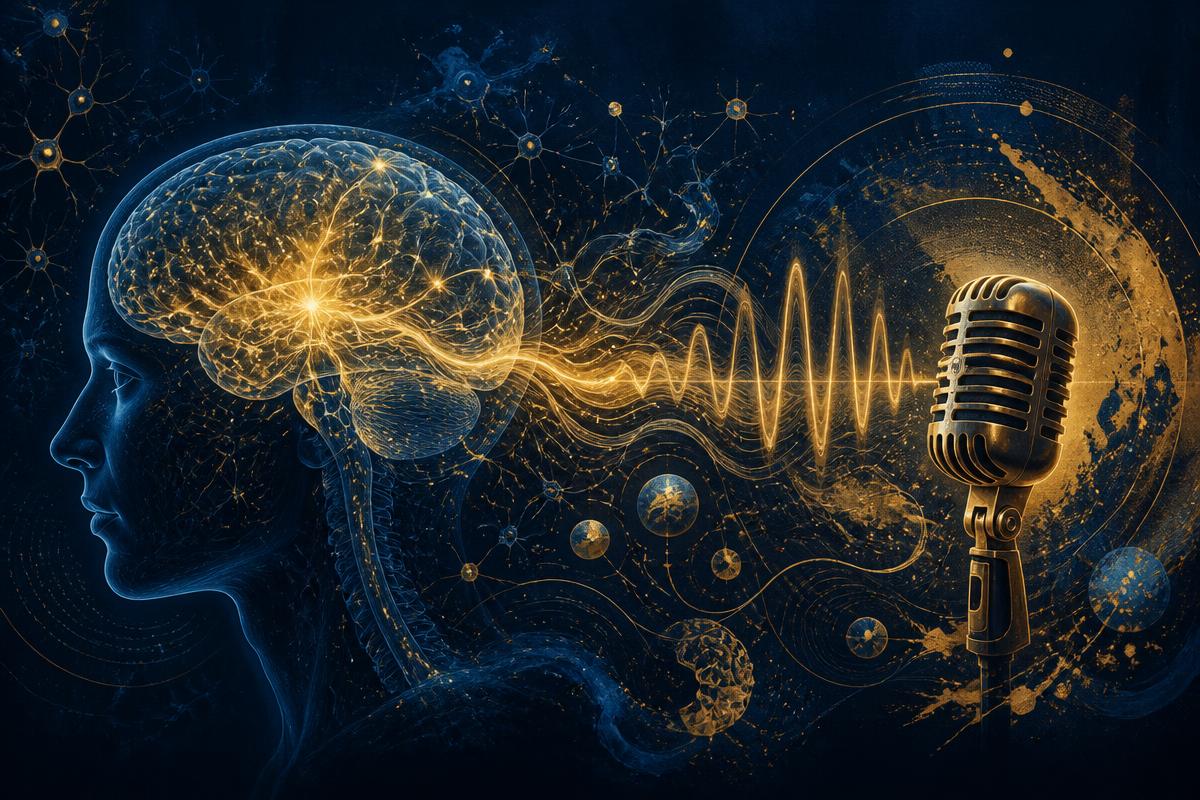
There is a moment in every great freestyle when the rapper seems to stop thinking and start receiving. Words arrive faster than they can be planned. Rhymes connect through associations the conscious mind has not yet approved. The crowd feels it too: a shift in the room, a sense that something is being channeled rather than constructed. For a long time, this was described as a spiritual or mystical experience. Now, neuroscientists are studying it as a measurable brain state.
The science of improvisation has grown rapidly over the last two decades, and freestyle rap has become one of its most valuable subjects. Unlike jazz, which is also studied but involves instruments, rap is pure language. It isolates the brain's language networks, memory systems, and executive control centers in a way that makes them easier to observe. When a rapper improvises, researchers can watch the brain make choices in real time.
What they have found is a pattern that looks a lot like meditation and a lot like play. The dorsolateral prefrontal cortex, an area associated with self-monitoring and critical evaluation, tends to become less active during improvisation. At the same time, areas linked to language, motor control, and emotional expression become more active. The result is a state in which the inner critic is quieted while the flow of ideas is amplified. This is why freestylers often report feeling both calm and energized, as if they are watching themselves perform.
The experience is not unique to rap. It resembles the flow states described by athletes, musicians, dancers, and meditators. The common thread is a narrowing of attention combined with a release of self-consciousness. Time seems to stretch or compress. The boundary between intention and action becomes thin. The rapper does not feel as if they are choosing the next word; they feel as if the next word is arriving.
This is why freestyle is sometimes described as a spiritual practice. Many cultures have traditions of spontaneous speech, chanting, or prayer that aim at a similar state. The goal is to get the planning mind out of the way so that something deeper can speak. Hip-hop may not use the same language, but the experience is familiar to anyone who has been in the zone.
The research has practical implications. Understanding how the brain enters flow could help people learn, perform, and recover from stress. It could inform education, therapy, and even the design of workplaces. The rapper who freestyles in a cypher is doing something that is not just art but also a demonstration of human cognitive flexibility.
02Memory and invention
One of the most striking findings is the role of memory. A freestyle is not created from nothing. It is assembled from a vast store of vocabulary, phrases, rhymes, and rhythmic patterns that the rapper has internalized over years. The brain draws on this archive automatically, combining stored elements in novel ways. This is why practice matters. Flow is not a gift from nowhere; it is the reward of deep preparation meeting present focus.
The best freestylers describe their minds as a library they can walk through at speed. They know their own catalog of rhymes so well that they can pull the right shelf without thinking. The improvisation happens at the level of selection and combination, not invention from scratch. This is why experienced rappers sound effortless while beginners struggle: they have built the internal database that flow requires.
Quote 01“The dorsolateral prefrontal cortex, an area associated with self-monitoring and critical evaluation, tends to become less active during improvisation.”
03The spiritual side
For some artists, the neuroscience confirms what they already felt. The zone is real, and it is not purely mechanical. It is a state of openness, a willingness to be used by the moment. This is where hip-hop meets older traditions of meditation, prayer, and ritual. The cypher becomes a kind of sacred space, governed by rules of respect and attention. The microphone is not just technology; it is an altar for the spontaneous voice.
The scientific framing does not diminish the experience. If anything, it makes the experience more remarkable. The brain is capable of generating coherent, meaningful, rhythmically complex language without conscious planning. That is a miracle by any measure. Understanding how it works does not make it less mysterious; it makes the mystery more specific.
Quote 02“The science of improvisation has grown rapidly over the last two decades, and freestyle rap has become one of its most valuable subjects.”

04What it means for the rest of us
Most people will never freestyle on a stage. But the flow state is available in many forms. It is the writer who loses track of hours, the cook who moves without recipes, the runner who forgets the miles. The lessons from hip-hop neuroscience apply broadly: prepare deeply, focus narrowly, quiet the critic, and trust the process.
The culture that grew out of block parties and basement cyphers has given science a new window into the mind. And science, in turn, has given the culture a vocabulary for what its best practitioners have always known. The freestyle is not just a skill. It is a glimpse into what human consciousness can do when it stops trying so hard.
Quote 03“The rapper who freestyles in a cypher is doing something that is not just art but also a demonstration of human cognitive flexibility.”